
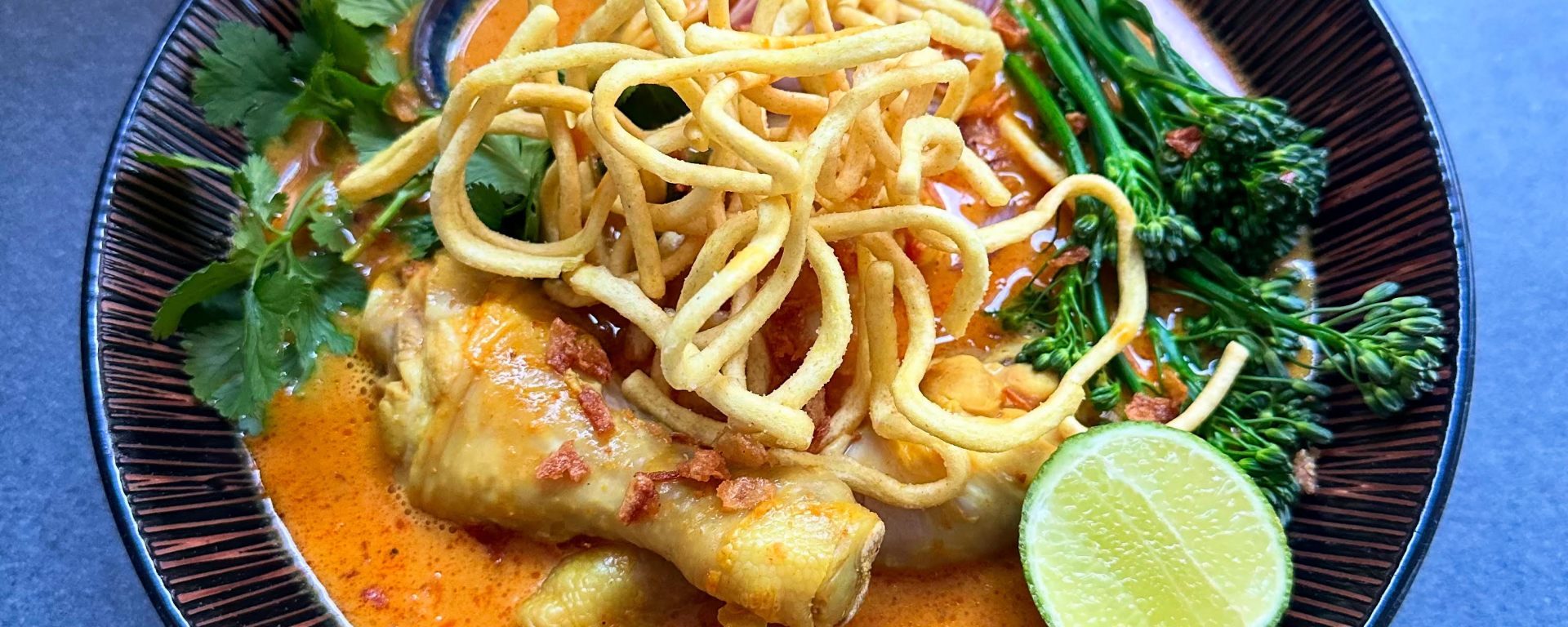
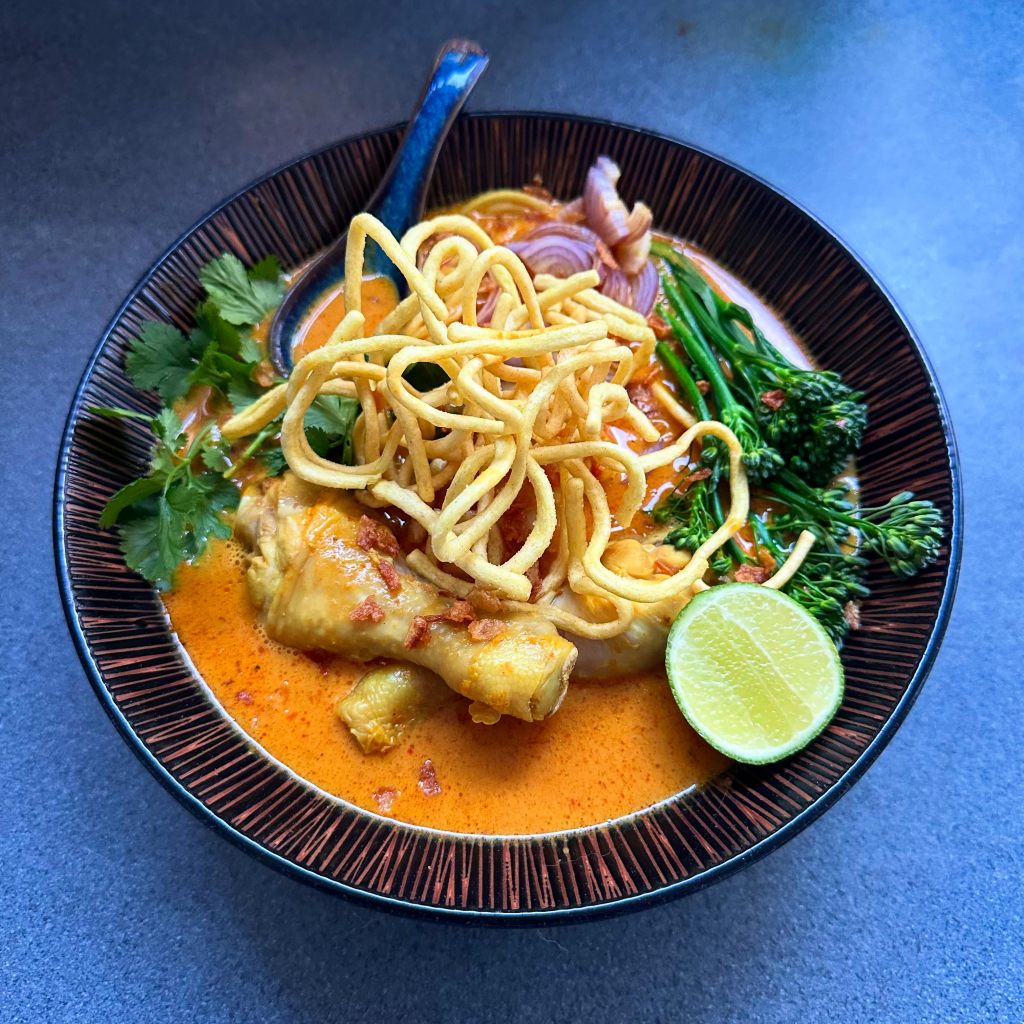
Thailand has a reputation for being a welcoming and tolerant country, and it’s history is testament to this. Throughout the centuries Thailand has served as a landing spot for many groups of people seeking safety and a better life – one of these groups were Muslims fleeing Yunan province in China. The Yunanese Muslims would come to settle in Northern Thailand and leave a lasting mark on the cuisine of the region. Of all the dishes they brought with them from Yunan, one would become synonymous with Northern Thailand (especially it’s largest city, Chiang Mai), and that is Khao Soi. Khao Soi is a delicious, hearty, rich curry noodle soup that is as comforting as it is impressive. A well balanced, spiced coconut soup base mingles with spices rarely seen elsehwere in Thai cuisine to create a dish that is a tribute to the cross road of flavours that have shaped Asian food as a whole.
Khao Soi has become increasingly popular in the West, and I remember when my family would go to our favourite spot for Pan-Asian food growing up that my mum would often default to it. I can see why, it is one of my favourite things to eat and I now always have some of the necessary curry paste stashed in my freezer for when the craving calls. Khao Soi is a great option for anyone who wants to venture into making their own curry pastes and learning some of the more technical aspects of making Thai food without hunting down harder to find ingredients. It also doesn’t require too much hands on cooking time once the paste has been made. On top of that it is almost impossible to overcook the curry itself, you can let it simmer away gently for a good while and not worry too much about it. Basically, it isn’t quite fool proof but it is as close as any recipe I’ll ever post is. I’ve also added information on how to make this a vegetarian dish. In Thailand you can find it made with beef as well as chicken. Personally I don’t eat beef, but I’d recommend using a cut ideal for slow cooking and braising if you wanted to use it in place of chicken.
Ingredient note: There are a few harder to come by ingredients in this recipe which are traditional to the modern version of Khao Soi but I have offered substitutions and alternate options where possible. The hardest things to track down are black cardamom pods and pickled mustard greens, but both will be found in most Asian grocery stores or on Amazon. The dried chillies for the paste are also slightly harder to find but any Indian grocery store or Amazon will have you covered.
In the ingredients section I refer to using ‘good stock’ if you aren’t using bone in chicken. The best stock to use is stock you’ve made yourself from chicken bones, or from kombu and other vegetables if making a vegetarian version. For any Asian recipe that calls for stock I have to stress that using shop-bought stock pots or cartons of stock won’t give you the desired flavour. In the West pre-made stock or stock pots are heavily flavoured to favour European dishes. They do this by adding herbs like rosemary or parsley that don’t exist in Asian cuisine. If you’re needing to use a shop bought stock for this dish please seek out chicken boullion from an Asian supermarket, usually the products sold under this label in an Asian supermarket will be more tailored to Asian cooking. For vegetarian cooks use kombu dashi powder but check the label carefully as some will contain fish.
Pro Tip: When making the paste you can use an immersion blender or a food processor, but I strongly encourage you to use a pestle and mortar. The reason for this is because the action of pounding the ingredients bruises cell walls and releases more flavour. Blending will make a smooth paste faster but will not make as flavourful a paste, meaning a less satisfying dish overall. The trade off is speed vs deeper flavour, and it is your call which is more important.
| Cuisine | Thai, Northern Thai |
| Makes | 2 Portions (paste for 4 portions) |
| Prep Time | 30 mins (if making paste with mortar and pestle) |
| Cook Time | 40+ minutes |
Paste ingredients:
Note this makes enough for 4 portions
- 9 dried large low spice chillies, typically I use Kashmiri red chillies or Guajillos.
- 2 dried Birds Eye chillies
- 1 tbsp coriander seeds
- 3 black cardamom pods or 6-8 green cardamom pods if you can’t find black cardamom
- 2 shallots
- 6 cloves of garlic
- 8 inch-thick rounds of ginger
- Pinch of salt, sugar, and msg
- 1.5 tbsp turmeric or 1 whole piece of fresh turmeric (don’t bother peeling)
Soup ingredients (serves 2):
- 1/2 your Khao Soi paste
- Egg noodles (enough for some to fry as well as to use as a bed for the soup)
- 400ml coconut milk
- 400ml water or a good stock if not using meat on the bone (refer to the ingredient note for info on what constitutes good stock).
- 2-3 bone-in chicken drumsticks per person (you could use boneless chicken thighs if you want but bone-in chicken is better).
- If using vegetarian options opt for things that can cook over a longer period of time and retain a pleasing texture – good options are kabocha squash, oyster mushrooms, or courgettes.
- Fish sauce and palm sugar to taste
Garnishes:
- Sliced lime for juice at diner’s discretion
- Chilli flakes
- Crispy fried egg noodles
- Fried shallots or onions – this isn’t traditional but easier than the fried noodles and can be shop bought
- Pickled mustard greens (if you can find, a must have for traditional Khao Soi)
- Raw shallot or red onion sliced
- Coriander leaves
- Leafy greens – again not traditional but a nice addition, especially if you can’t find pickled mustard greens
Paste method:
- Begin by soaking dried chillies in a bowl with just-boiled water, leave for 40 minutes to an hour.
- De-seed cardamom pods, keeping the seeds and discarding the pith, toast with coriander seeds in a hot pan for 30 seconds to 1 minute or until fragrant.
- Grind the seeds, either use a pestle and mortar or a spice grinder.
- Toast ginger in pan with the shallots and garlic cloves, if you have access to fresh turmeric toast this too. Toast until some colour has developed and everything is fragrant.
- Remove ground spices from pestle and mortar (if using) and set aside.
- Pound chillies into a fine paste, you can discard seeds if concerned about the paste being too spicy. You want to use a motion where you crush the chillies against the base of the mortar with the pestle and be aggressive.
- Gradually add toasted aromatics (ginger etc) and pound until you have a cohesive paste.
- Return ground spices and add salt, sugar, and msg.
- Combine all pounded ingredients until smooth and cohesive.
If using a stand blender combine all ingredients and blend until a smooth and cohesive paste forms.
Reserve paste you don’t use (approx half if making Khao Soi for two) and store in the freezer in an airtight container.
Soup method:
- Make the fried noodle garnish, to do this deep fry noodles for 1-2 minutes and reserve for when serving. The oil should be 175°C or 350°F. When the noodles hit the oil they should expand and become rigid on impact. Carefully turn them over once.
- Let fried noodles drain on a wire rack or paper towel to drain and reserve until plating up the soup.
- Toast paste in a deep and tall pan with a 1tbsp neutral oil, do this until a yellow-orange oil starts to form.
- Deglaze with coconut milk and add chicken if using, if not add vegetarian substitutes at a time that feels intuitively appropriate.
- Add stock/water, turn pot to simmer and leave to cook for at least 20 minutes. Monitor consistency, if the soup begins to appear too thick add more water and stir though. This will not impact flavour.
- Allow the soup to simmer on a medium heat until chicken or vegetables are fork tender. Taste to season, adding fish sauce if salt is needed or palm sugar if some sweetness is needed. The chicken should have an internal temperature at the thickest part away from the bone of 80°C or 175°F.
- Cook remaining noodles to packet instructions. Place in base of serving bowl.
- Prepare garnishes (slicing limes, etc)
- When soup is looking rich, a slightly thick but runny consistency, and ingredients are fork tender serve over a bed of noodles.
- Add garnishes and serve warm, if the soup requires more salinity add fish sauce or soy over salt.
 Fresh Hot Chapatis